Post #4 From Miracles to Emmanuel – Learning about Emmanuel
From the beginning, our adoption agency had told us that in international adoptions there is a lot of misinformation about the adoptive children. They said diagnoses, abilities, disabilities, and all other information may get lost in translation, not cross over different cultures, or just be falsely reported or documented. We saw this with Mila. “Does she have swallowing issues?” They had answered no. But she seemed to choke and sputter while taking any thin liquids in Colombia, and we couldn’t wait to get her home to be evaluated. Sure enough, she did have significant issues with swallowing. For two years we thickened her liquids, first to honey consistency and later to nectar, until finally she could swallow without aspirating. I also began her first cardiology appointment telling them she had an atrial septal defect repair, only to have them examine her and inform me it had been a ventricular septal defect. We had been misinformed. Perhaps our agency made the mix up, perhaps the translator got confused, or perhaps Colombia has different names for heart chambers, but either way, we didn’t need much convincing this time that perhaps what we read about Emmanuel on paper may not be what we would see at encuentro.
All along we knew Emmanuel’s development was delayed. We didn’t receive much information but what little we did receive said he sometimes needed support to sit up. One report mentioned he made attempts to crawl and pull up. Since he was already two years old, we knew this was a major delay in his motor skills. We prepared for an immobile child, not expecting him to walk before getting him. But just two weeks before we traveled, we learned that he had suddenly begun walking. I looked at the email in disbelief. How could a child who needed help sitting up be walking? I’m ashamed to say when we saw in writing the things we had spent months praying over, we questioned the new report.
Four days before we were to travel, we had our very first video call with Emmanuel. We were dressed in pastel clothing similar to what we would wear for encuentro. We had pulled out the cardboard cows that we had used during Mila’s video calls to sing every Colombian child’s favorite song “La Vaca Lola.” We gathered close as we sat on the hearth of our fireplace with the computer in front of us. There were a couple people who joined the video call from ICBF and one from our team to aid with the communication.
After a brief introduction, they announced Emmanuel had arrived for the call and the social worker who had him turned on her camera. There he was. For almost two years we had looked at old pictures of him and wondered how he was growing and developing, and now we saw him live on video. He was alert, curious, and so beautiful. Meeting our child through video felt somewhat awkward just as it had with Mila. “Hola, Emmanuel. Soy tu mama y te amo mucho!” We all greeted him. We sang La Vaca Lola with our cardboard cows and caught his attention on the screen. We were overjoyed when he began to sway his head back and forth as we sang.
Our video call lasted about as long as his attention span. He was squirmy and wanted to explore the new office where the video meeting was held. They put him down, and we got to see with our own eyes him walking as they tried to keep him in the camera’s view. Our meeting was brief, and we soon told him goodbye. They got him to blow us kisses and our hearts almost melted. Signing off wasn’t too hard knowing that we would see him in person in a week’s time at his encuentro.
After the video call, we sat and marveled. When Emmanuel was just a few months old, he had been assigned to live in a medical institution because his needs were deemed too great for living with a foster family. All along we had been preparing for a child with severe special needs, and we were overjoyed with what we saw on that video call. We saw a healthy little boy who was active, engaging, walking, and so very busy.
Since encuentro and bringing him into our family, we have continued to marvel. We had been told that he only babbled and had no words. Yet, very quickly, we began to realize that he could say “Dada,” “Agua,” and “Oh no.” And he is learning and trying to say so many new words each day. In Colombia we sang songs together at bedtime, and before long, he began singing along. He bobbed his head and joined in as he mimicked the sounds to “La Vaca Lola,” “Los Pollitos,” and “Mi Carita.” He began to say “Baby Mine” as he requested our family’s special bedtime song.
It is difficult to put into words what it felt like to say yes to a child living in a medical institution and then meet Emmanuel. He had been surrounded by children with feeding tubes, children who were immobile, and children who had little emotional or cognitive response. Every one of those children is precious and deeply loved by God. But God had told us to get Emmanuel.
I hadn’t looked through pictures and chosen a child. God had been specific. He had led us to Emmanuel before we knew what Emmanuel would be like or what his future might hold. And now, seeing him walking, learning, singing, and thriving, I can only imagine the plans God has for our little guy. I pray they are big plans, plans that continue to reveal God’s goodness and bring Him so much glory.
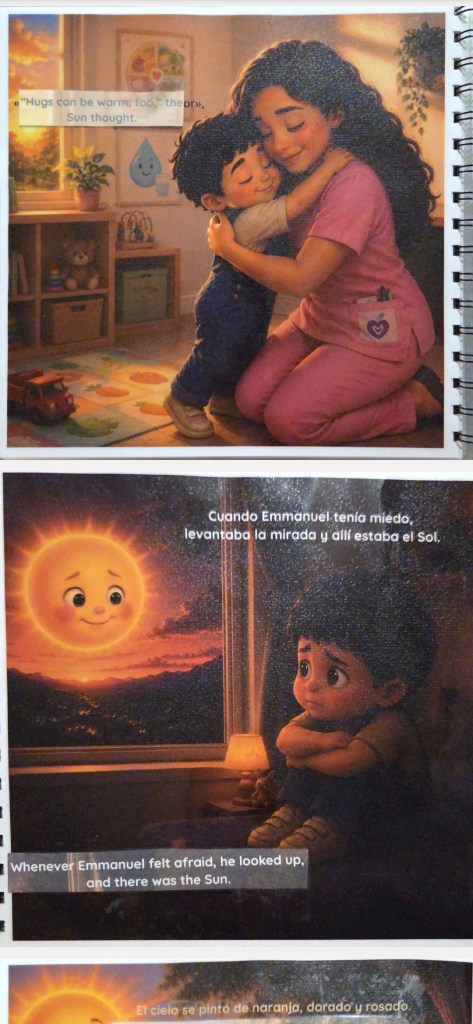
One of the most treasured keepsakes we have from Colombia is a handmade book we received from one of Emmanuel’s caregivers dedicated to Emmanuel and our whole family.
The caregiver writes to Emmanuel in her dedication:
“I will treasure every memory of the moments we shared together. Watching you grow has been one of the greatest blessings God has placed in my life, and I thank Him every day for giving me the privilege of caring for you during this part of your journey.”
The next pages are a story she writes about a little boy named Emmanuel. The story begins with Emmanuel playing outside. One day, he notices the sun, and the sun notices him too. Emmanuel tells the sun his name and asks, “Are you always here?” The sun replies, “I am here as long as God allows me to be.”
From that day on, the sun watches Emmanuel grow. He sees Emmanuel play and share with others. He watches him run, explore, and laugh. He notices how Emmanuel’s laughter brings joy to those around him and how his hugs are warm.The sun looks down on Emmanuel and thanks God for the light He has placed inside him.
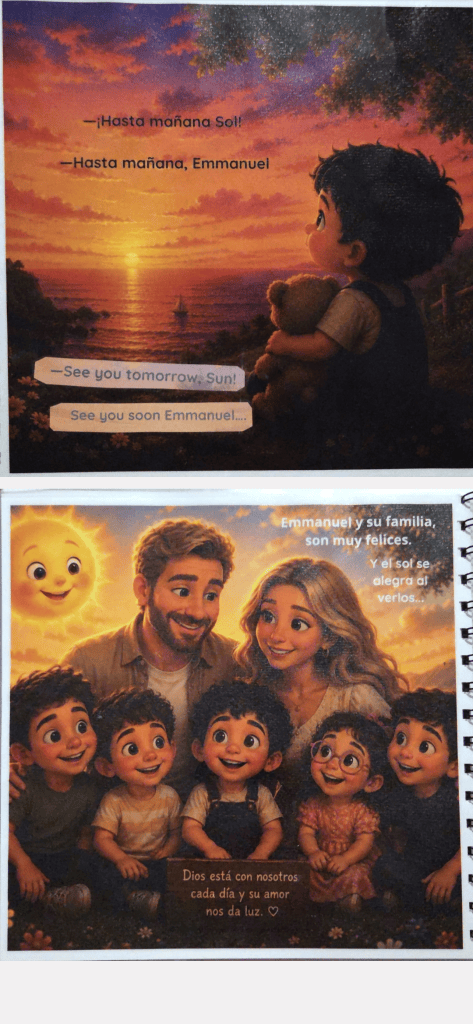
One evening, as the sun begins to set, Emmanuel asks, “Is it already time for you to go?” The sun replies, “It is. But if God allows, I will see you again tomorrow.” They say goodbye to one another, and before the sun disappears, he tells Emmanuel, “And always remember, Emmanuel, just as your name means, God is with you, and He will watch over you.”
The book is illustrated with images of a dark curly headed boy with big eyes. On the cover, is a picture of Emmanuel hugging a caregiver with long wavy hair. At the end, it shows a picture of Emmanuel with his family – dad, mom, and four siblings. On that page are the words, “Emmanuel and his family are happy, and the sun is happy to see them. God is with us each day, and His love gives us light.”
This book brought tears. Through all the waiting, we had prayed for God to send people to care for Emmanuel when we couldn’t be there for him. This book is evidence that God answered that prayer.
In my next post, I will highlight some of the events that happened while we were in Colombia finalizing Emmanuel’s adoption.